Why does toast always seem to land butter-side down? You’ve probably asked that at least once, usually while scraping jam off the kitchen floor. The honest answer involves table height, rotation speed, and a generous dose of confirmation bias. The better answer is that you’ve just done real science. You noticed something, you wondered why, and you started forming an explanation. That’s the whole game. Learning how to get started with everyday science isn’t about buying a microscope or memorizing the periodic table. It’s about taking the curiosity you already have and giving it a bit of structure.
Most people assume science belongs to people in white coats, working in buildings with keycard access. But science is really just organized curiosity. It’s what happens when you stop accepting “that’s just how it works” and start poking at the edges of an idea to see if it holds up. You can do that with a frying pan, a bar of soap, a packet of yeast, and about ten minutes of your evening.
What Everyday Science Actually Means
Everyday science is the practice of treating ordinary moments as small research opportunities. It doesn’t require equipment, funding, or permission. It requires attention. When you notice that your kettle boils faster with the lid on, or that your bread goes stale faster in the fridge than on the counter, you’re collecting data. You’re just not writing it down yet.
The mindset shift is simple but surprisingly powerful. Instead of asking “what’s the right answer?”, you ask “what could I test?” That small swap turns a passive day into an active one. Suddenly the kitchen becomes a lab, the bathroom becomes a lab, and your walk to the shops becomes a field study in how puddles form and where they drain.
There’s no entry exam for this. You don’t need to know the difference between a hypothesis and a theory before you begin, though you’ll pick it up along the way. You don’t need to be good at maths. You don’t need to have enjoyed science at school. In fact, plenty of people who disliked science lessons turn out to be brilliant everyday scientists, because the classroom version often strips out the part that makes it fun: the messing about.
One useful reframe is that everyday science is less about finding answers and more about improving your questions. A good question is specific, testable, and small enough to answer before your tea goes cold. “Why is the sky blue?” is lovely but huge. “Why does my tea look lighter when I add milk slowly rather than all at once?” is something you can actually investigate tonight.
The Observe, Question, Test Loop
Every piece of science, from a school experiment to a particle accelerator, follows the same basic loop. You observe something. You ask a question about it. You make a guess. You test the guess. Then you look at what happened and adjust. That’s it. The loop is the engine, and once you’ve internalized it, you’ll start running it automatically.
Observe means paying attention without rushing to explain. This is harder than it sounds. Our brains love to jump straight to a story. Try to linger in the noticing stage for a moment. What exactly did you see, hear, smell, or feel? How many times have you seen it? Does it happen every time, or only sometimes?
Question means turning that observation into something you could actually check. A good question has a clear yes-or-no or a measurable outcome. “Does the toast always land butter-side down?” is decent, but “does toast land butter-side down more often when dropped from waist height than from knee height?” is better. You can test that. You can count it. You can compare.
Test means changing one thing at a time and seeing what happens. This is where most home experiments go wrong, and it’s also where the real learning lives. If you change three things at once, you won’t know which one mattered. Keep it simple. Change one variable, keep everything else the same, and repeat the test a few times. A single result is an anecdote. Three or four results start to look like a pattern.
Then you close the loop. Did the result match your guess? If yes, great, but don’t stop there. Could something else explain it? If no, even better. A failed prediction is a gift, because it tells you your mental model was incomplete. Adjust and go again. This is not failure. This is the process working exactly as intended.
You’ll also want to get comfortable with the idea of a control. If you’re testing whether warm water freezes faster than cold water, you need to freeze both under the same conditions, in the same kind of container, in the same spot in the freezer. Otherwise you’re comparing apples to ice cubes. Controls feel fussy, but they’re what separate a fun observation from a reliable one.
Three Easy Starter Activities
If you’re not sure where to begin, pick one of these. Each uses things you already own, takes under half an hour, and leaves you with something genuinely interesting to think about.
1. The kitchen sink density column. Grab a clear glass or jar. Slowly pour in a layer of honey, then a layer of golden syrup, then a layer of washing-up liquid, then water with a bit of food colouring, then a layer of vegetable oil. Let each layer settle before adding the next. You’ll end up with a stack of liquids that refuse to mix. Now drop in small objects one at a time: a grape, a paperclip, a piece of cork, a cherry tomato. Some will sink, some will float, some will hover at a boundary. The question to ask is why. The answer is density, but the fun part is predicting where each object will land before you drop it. You’ll be wrong at least once, and that’s the point.
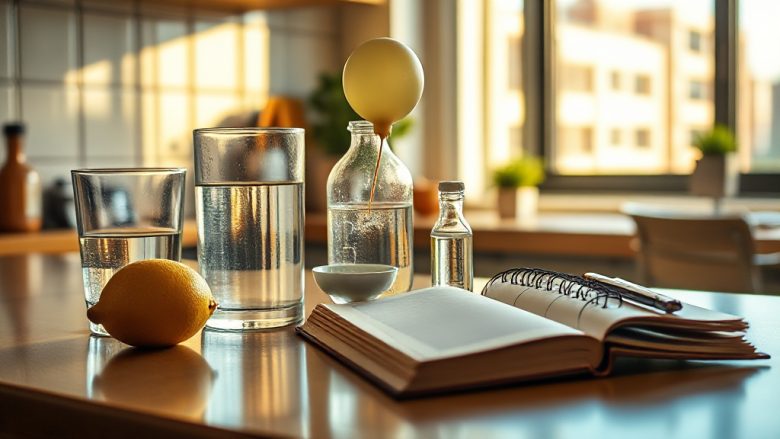
2. The yeast breath test. This one is brilliant for anyone who has ever wondered how bread rises. Take three small bottles or glasses. In each, mix a teaspoon of dried yeast with a teaspoon of sugar and a splash of warm water. In the first, use water that’s cool from the tap. In the second, use water that’s comfortably warm, like bath temperature. In the third, use water that’s hot but not boiling. Stretch a balloon over the neck of each bottle and wait twenty minutes. The balloons will inflate at different rates. The yeast is alive, it’s eating the sugar, and it’s producing carbon dioxide gas. The temperature changes how fast that happens. You’ve just run a controlled experiment with three conditions and a measurable outcome.
3. The shadow length tracker. Pick a fixed object outside, like a fence post or a lamp post. At the same time each day for a week, mark where the tip of its shadow falls. You’ll see the shadow shift, lengthen, and shorten. This is the Earth tilting on its axis as it orbits the Sun, made visible with nothing more than chalk and patience. It’s also a lovely way to notice how much the seasons are already moving around you, even when the weather feels the same.
Each of these activities gives you something to observe, something to measure, and something to be surprised by. That last part matters more than people admit. Surprise is the feeling of your model being updated, and it’s the most reliable sign that you’re actually learning.
Keeping a Journal That Actually Gets Used
A journal is the difference between a fun afternoon and a growing body of knowledge. But most people start journals with grand intentions and abandon them within a week. The trick is to make it small, messy, and useful.
Forget the leather-bound notebook. A cheap exercise book, a notes app, or even the back of an envelope will do. What matters is that you write down four things: what you did, what you expected, what happened, and what you now think. That’s it. Four lines per entry. If you want to add a sketch or a photo, great, but it’s optional. The point is to create a record you can look back on.
Date every entry. This sounds obvious, but you’ll thank yourself later when you’re trying to remember whether the yeast experiment was faster in winter or summer. Note the conditions too: room temperature, time of day, whether the window was open. Small details that seem irrelevant now often turn out to be the thing that explains a weird result later.
Review your journal every few weeks. Look for patterns you didn’t notice at the time. Maybe your bread always rises better on days when you’ve left the dough near the radiator. Maybe your houseplants perk up after you’ve boiled the kettle nearby. These connections are where everyday science gets genuinely exciting, because you’re no longer running isolated experiments. You’re building a picture of how your own little corner of the world works.
And be kind to yourself about gaps. You won’t write every day. You won’t always finish an experiment. That’s fine. The journal isn’t a performance. It’s a thinking tool, and thinking tools are allowed to be scruffy.
The real reward of everyday science isn’t a set of facts. It’s a habit of mind. Once you start noticing, questioning, and testing, the world stops being a backdrop and becomes a place full of small, answerable mysteries. The toast will still land butter-side down sometimes. But now you’ll know why, and you’ll probably drop it again on purpose just to check.