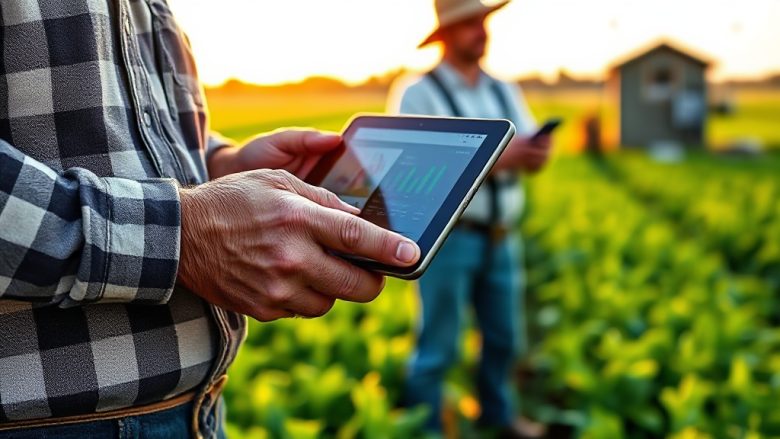
You’re standing at the edge of a forty-acre field with your phone in one hand and a soil probe in the other. A podcast is telling you to install sensors everywhere. A neighbor swears by a satellite subscription. Someone at the co-op mentioned variable-rate seeding like it’s the only way forward. By the time you’ve scrolled through three articles, you feel like you’re already behind — and you haven’t even decided what to plant next season.
I’ve spent years working as an agricultural extension officer, and I’ve watched this exact scene play out in farm kitchens, truck cabs, and field days across the country. The truth is that most expert advice on smart farming isn’t wrong. It’s just aimed at operations with a different scale, a different budget, and a different tolerance for risk. What follows is a practical filter — a way to sort the useful from the noise and figure out what actually earns its place on a small farm.
Why Expert Advice on Smart Farming Often Misses the Mark
The first thing to understand is where most smart farming recommendations come from. They’re built for operations that measure land in thousands of acres, where a one percent yield improvement justifies a six-figure technology spend. That math doesn’t transfer to a farm where every dollar has to pull its weight.
That doesn’t mean small farms should ignore technology. It means the advice needs translating. A recommendation to deploy a full sensor mesh across every field becomes, for a small grower, a question of which two fields would benefit most from a single moisture probe. A pitch for autonomous tractors becomes a conversation about whether a simple guidance system on your existing machine would reduce overlap and save fuel.
Good expert advice on smart farming should do three things. It should solve a problem you actually have, it should pay for itself within a reasonable timeframe, and it should not require you to become a part-time IT technician. If a recommendation fails any of those tests, it’s probably not for you right now — and that’s fine.
There’s also a psychological trap worth naming. Technology vendors and even well-meaning advisors tend to present adoption as a binary: either you’re a modern, data-driven farm or you’re stuck in the past. That’s nonsense. Farming has always been a mix of old and new, and the best small farms I’ve visited are ruthlessly selective about what they adopt. They don’t chase every tool. They pick a few that fit.
So before you buy anything, before you sign up for any platform, ask a simple question: what specific decision will this help me make better? If you can’t answer that in one sentence, keep your money in your pocket.
The Three-Tier Adoption Model: What to Try First, Second, and Later
Over the years, I’ve found it useful to sort smart farming tools into three tiers based on cost, complexity, and how quickly they tend to pay off. The idea isn’t to prescribe a rigid sequence — every farm is different — but to give you a starting point when you feel overwhelmed.
Tier One: Low-Cost, High-Clarity Tools
These are the tools I recommend to almost every small farm, regardless of what they grow. They’re cheap, they’re simple, and they answer questions you’re probably already asking.
Soil moisture sensors are the classic example. A single reliable probe in a representative part of a field can tell you whether you’re irrigating too early, too late, or just right. You don’t need a network of them to start. One probe, checked regularly, will teach you more about your soil’s behavior than a season of guessing.
Weather stations that log local conditions are another Tier One tool. Regional forecasts are useful, but they can be miles off from what’s happening on your ground. A basic on-farm station that records rainfall, temperature, and humidity gives you a record you can compare against year after year. That record becomes genuinely valuable over time.
Simple record-keeping apps deserve a mention too. Not the ones that promise to revolutionize your operation, just the ones that let you log field activities, inputs, and observations in a consistent way. The value here isn’t the app itself — it’s the habit of writing things down in a format you can actually search later.
Tier Two: Moderate Investment, Clear Returns
Once you’ve got the basics working, Tier Two tools start to make sense. These cost more and require a bit more setup, but they tend to pay for themselves within a season or two on farms that have a specific problem to solve.
GPS guidance systems for tractors fall into this category. If you’re doing a lot of row crop work, a basic guidance setup can reduce overlap, cut fuel use, and make your passes more consistent. It’s not cheap, but it’s a known quantity — the savings are measurable, and the learning curve is manageable.
Variable-rate application equipment is another Tier Two option, but only if you’ve already got good soil data to work from. Applying fertilizer at different rates across a field sounds smart, but it’s only smart if you know which parts of the field need more and which need less. Without that data, you’re just adding complexity.
Remote monitoring for irrigation or livestock is a third Tier Two candidate. Cameras and sensors that let you check on things without driving out to the far field can save real time, especially if your operation is spread out. The key is to pick a system that works reliably without constant fiddling.
Tier Three: High-Cost, High-Commitment Tools
Tier Three is where most of the hype lives. Drones with multispectral cameras, AI-driven disease detection, autonomous machinery, full farm management platforms that integrate everything. These tools can be genuinely powerful, but they demand significant investment — not just money, but time and attention.
For most small farms, Tier Three tools are a later-stage consideration, if they’re a consideration at all. That’s not a criticism. It’s just an honest assessment of where the returns are. If you’re managing a few dozen acres with a small team, the marginal benefit of a drone-based crop scouting system may not justify the cost and the learning curve, especially when a walk through the field with a notebook still works remarkably well.
There’s one exception worth noting. If you have a very specific, high-value problem — say, a specialty crop with a narrow harvest window, or a pest that’s historically cost you a significant portion of your yield — a Tier Three tool aimed directly at that problem might be worth it. The key is specificity. Don’t adopt Tier Three technology because it’s impressive. Adopt it because it solves a problem that’s costing you real money.
Common Mistakes Farmers Make With Smart Farming Advice
The mistakes I see most often aren’t about picking the wrong technology. They’re about how farmers approach the decision in the first place. Here are the patterns worth watching for.
The first mistake is buying before diagnosing. It’s tempting to start with a solution — a sensor, a platform, a piece of equipment — and then look for a problem it can solve. That’s backwards. Start with the problem. What’s costing you time, money, or sleep? What decision do you keep making on gut feel because you don’t have better information? Answer that first, then look for tools that address it.
The second mistake is underestimating the time cost. Every new tool comes with a learning curve, and that curve eats into the time you’d otherwise spend on actual farming. A tool that saves you two hours a week but takes three hours a week to manage isn’t a win. Be honest about how much time you’re willing to invest, and factor that into your decision.
The third mistake is chasing integration. There’s a strong pull toward systems that connect everything — sensors talking to software talking to machinery talking to your phone. In theory, that’s elegant. In practice, integration often means you’re locked into one vendor’s ecosystem, and if one piece breaks, the whole thing gets complicated. For small farms, simple standalone tools that do one job well are often a better bet than an integrated system that does everything adequately.
The fourth mistake is ignoring the human side. Smart farming tools work best when they fit into your existing routines. If a tool requires you to change how you work in a way that feels unnatural, you probably won’t stick with it. The tools that last are the ones that become invisible — you check the sensor while you’re already out in the field, you glance at the weather station data while you’re having coffee. If using a tool feels like a chore, it’s not the right tool for you.
A Simple Checklist Before You Adopt Any Smart Farming Tool
Before you spend money on anything, run it through this short checklist. It won’t take long, and it’ll save you from a lot of regret.
First, name the problem. Write it down in one sentence. If you can’t, you’re not ready to buy.
Second, estimate the return. How will this tool save you money, time, or risk? Be specific. “It’ll make things easier” isn’t a return. “It’ll cut my irrigation water use by a measurable amount” is.
Third, check the time cost. How long will it take to learn, and how much ongoing time will it require? Add that to the price tag.
Fourth, start small. If you can test a tool on one field or one part of your operation before committing fully, do that. A season of small-scale use will teach you more than any sales pitch.
Fifth, talk to someone who’s actually used it. Not a vendor, not a reviewer — another farmer. Ask what surprised them, what they’d do differently, and whether they’d buy it again.
Finally, give yourself permission to say no. Not every tool is for every farm. The goal isn’t to adopt the most technology. It’s to run a farm that works — profitably, sustainably, and in a way that lets you sleep at night. Expert advice on smart farming is only useful if it serves that goal. Everything else is just noise.